Most operators evaluate the risk of switching platforms. Few look as closely what staying put could prevent them from doing next. Here are the signs that it may be time to switch, the risks worth weighing and what the right move could unlock for your service.
The Leyra Team
Most operators who are unhappy with their OTT platform can already see where the frustrations are building. What takes longer is deciding whether that unhappiness is a genuine ceiling on growth, or a set of irritations worth living with a little longer.
The decision is often weighed against only one side of the risk. Operators ask themselves whether a migration might go wrong, and that is a fair question. Fewer ask what another year on the current platform could cost in delayed launches, operational effort or missed opportunities. Once those consequences are made visible, the decision tends to look different.
The point to consider switching is when platform limitations stop being manageable inconveniences and start affecting where the service can launch, how it can make money or how quickly the team can respond to its audience.
The signals you've outgrown your platform
A platform rarely fails outright. It just stops keeping pace, and the gap shows up in specific, checkable places over time.
- Growth is asking for something the roadmap can't give you. A big-screen app, a new monetisation model or support for a market with different rights requirements. These requests keep landing on the vendor's backlog with no committed date attached
- The operational cost is rising rather than falling. Launching a new promotion, onboarding a new content partner, or making a pricing change takes more manual effort than it did a year ago, not less.
- You've started building around the platform instead of on it. Spreadsheets tracking entitlements the platform should track natively. A side tool patched in because the core system can't support something the service now depends on.
- The roadmap conversation with your vendor is getting shorter. This one is easy to miss because it shows up gradually. Fewer questions from the vendor about where the service is heading, and less clarity about how its roadmap supports yours.
Taken together, these are not simply signs that a platform is becoming harder to work with. They suggest that a different platform could give the service more room to grow, support new commercial opportunities and free the team from workarounds that absorb time without improving the audience experience.
As the streaming market consolidates and audiences become more selective, operators have less room for technology constraints that slow down launches, limit commercial options or absorb resources that could be spent improving the service.
Why switching gets delayed
Even when the signals above are clear, most operators wait longer than they should to act on them. The reason is often as much organisational as technical.
Switching platforms means revisiting integrations, contracts and established ways of working. The decision may also sit across product, finance and engineering, which can make ownership unclear and delay action. Add a natural wariness about disrupting a service that is still running, and the conversation can keep getting pushed back.
What finally changes the conversation is often a forcing event. A competitor launches a big-screen app first. A content deal falls through because the platform can't support the rights structure. Those moments make the decision urgent, but by then the operator may already have absorbed a year or more of delays, workarounds and missed opportunities.
The better time to evaluate a switch is before a platform limitation becomes an urgent commercial problem. That gives the operator more time to choose the right partner, plan the transition properly and make the move on its own terms.
What to be realistic about
An experienced platform provider with a track record of migrating multiple customers can manage much of the process, but the transition will still require focused input from product, engineering and customer support. The decision is easier to make when the internal commitment, responsibilities and expected outcomes are clear from the start.
The new platform also needs to support more than the operator’s immediate requirements. Its roadmap, operating model and flexibility should give the service room to evolve over time.
Weighing the two honestly
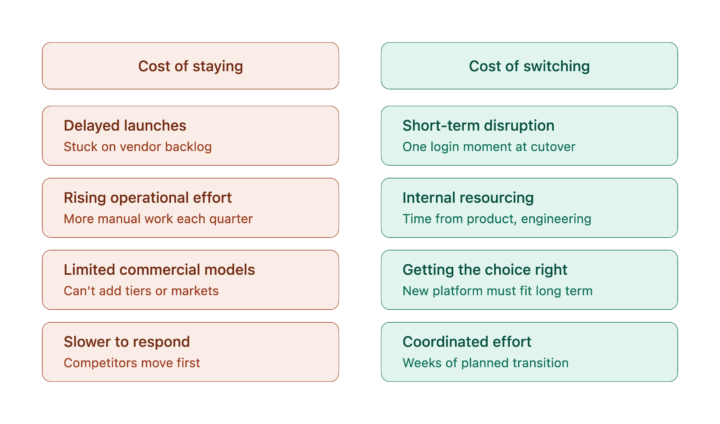
The clearest way to make this decision is to consider the cost and effort of switching alongside the likely impact of staying on the current platform.
A few questions help make that comparison concrete:
- If nothing changes, where is the service in 18 months, and is that an acceptable outcome?
- Which capabilities needed for the next stage of the service still have no credible delivery path?
- Would switching solve the actual constraint, or just move it somewhere else?
- Is the team building workarounds for a genuine platform limitation, or because the available options have not been fully explored?
- What does the current vendor's engagement with your roadmap look like today, compared with two years ago?
- What could the team launch, improve or commercialise if the current platform constraints were removed?
Answered honestly, these questions tend to separate operators who are dealing with a genuine ceiling from those dealing with a temporary rough patch.
If the limitations are affecting growth, commercial flexibility or the team’s ability to improve the service, switching should not be seen simply as a technical replacement project. It can be an opportunity to give the service a stronger foundation for what comes next.
Planning the migration
At Leyra, our early conversations with customers looking to migrate usually begin with what the service needs to achieve next: broader device coverage, new routes to market, greater monetisation flexibility or a more efficient way to operate. From there, we look at how Leyra can support those ambitions and what the transition would need to deliver.
For some operators, the existing platform has clearly run out of room. For others, the challenge is a specific gap, such as big-screen support or a monetisation model the current setup cannot handle, and the right solution may be narrower than a full migration.
Leyra provides the platform and expertise to support the service’s next stage of growth. We give operators an end-to-end foundation for managing content, monetisation, subscribers and apps, with the flexibility to keep evolving as priorities change.
An honest evaluation is part of that process. We are direct about what Leyra can and cannot do for a service, as well as what the migration will require from the operator’s own team before any commitment is made.
The goal is to give operators more freedom to launch, adapt and improve over time, without repeatedly running into the same platform limitations.
When switching becomes the right move
For the right service, switching platforms can create more freedom to grow, introduce new commercial models and improve the audience experience without increasing operational strain.
Once the case for switching is clear, the next question is how to make the move without unnecessary disruption. Read the second part of the series for a closer look at the main OTT platform migration challenges and how to navigate them.
If you are considering switching OTT platforms, book a demo with Leyra. We can talk through what your service needs next, the limitations you are running into and how Leyra could support the transition.
You can also download the full Leyra feature specifications to explore the platform in more detail.
Follow Leyra on LinkedIn for more insights on building, growing and evolving streaming services.